Advanced Engineering Chemistry, Second Edition
Chapter 2: Spectroscopy and Photochemistry

2.1 INTRODUCTION

The instrumental methods of analysis are now being extensively used for the qualitative analysis and identification of organic compounds. The most useful of these methods are the diffraction method and the spectroscopic method. We will study about spectroscopic methods in this chapter.

2.2 DISPERSION OF WHITE LIGHT AND THE VISIBLE SPECTRUM

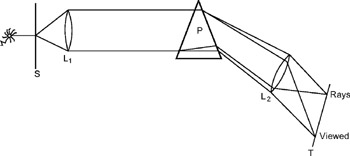
The apparatus for producing a spectrum of white light is shown in Fig. 2.1. When a beam of light from a source F (a tungsten filament lamp) is selected by the narrow slit S and allowed to fall on a prism P by a collimating lens L 1, a band of seven colors can be focused on screen T with the help of an object lens L 2. The phenomenon in which white light is separated into various colored components or wavelengths is called dispersion. The colored components range from red through orange, yellow, green, blue, and indigo to violet. These colors diffuse gradually into each other. The band of colors is known as a spectrum. (Note: spectra is the plural of spectrum.)


Figure 2.1: The optical spectroscopy.

The complete optical system for producing and viewing the spectrum is known as an optical spectroscope. A simple spectroscope consists of the following parts (Fig. 2.1).

Source (F): Generally nonvolatile incandescent solids radiate white light, hence a tungsten filament lamp is often used. Sunlight is also essentially white.

Slit (S): Limits the width of the beam from the source. The slit is...

UNLIMITED FREE
ACCESS
TO THE WORLD'S BEST IDEAS

SUBMIT
Already a GlobalSpec user? Log in.

This is embarrasing...

An error occurred while processing the form. Please try again in a few minutes.

Customize Your GlobalSpec Experience

Category: Spectral Lamps
Finish!
Privacy Policy

This is embarrasing...

An error occurred while processing the form. Please try again in a few minutes.