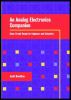
An Analog Electronics Companion: Basic Circuit Design for Engineers and Scientists
Part 1: Mathematical Techniques

Overview

Philosophy is written in this grand book I mean the universe which stands continually open to our gaze, but it cannot be understood unless one first learns to comprehend the language and interpret the characters in which it is written. It is written in the language of mathematics, and its characters are triangles, circles, and other geometrical figures, without which it is humanly impossible to understand a single word of it; without these one is wandering about in a dark labyrinth.

Galileo Galilei (1564 1642)

As indicated in the preface, this book is substantially about design and hence prediction. The tools that allow us to extrapolate to create a new design are an understanding of the physical characteristics and limitations of components, mathematical techniques that allow us to determine the values of components and responses to input signals, and of course as much experience as one can get. The latter of course includes making as much use as possible of the experience of others either by personal contact or by consulting the literature.

This part covers much of the basic mathematics that is generally found useful in analysing electronic circuits. There is a fairly widely propagated view that you can get by without much mathematical knowledge but I evidently do not subscribe to this. Many do indeed do very well without recourse to mathematics but they could do so much better with some knowledge, and this book is, in part, an attempt to persuade them to make the...

UNLIMITED FREE
ACCESS
TO THE WORLD'S BEST IDEAS

SUBMIT
Already a GlobalSpec user? Log in.

This is embarrasing...

An error occurred while processing the form. Please try again in a few minutes.

Customize Your GlobalSpec Experience

Category: Liquid Crystal Display (LCD) Modules
Finish!
Privacy Policy

This is embarrasing...

An error occurred while processing the form. Please try again in a few minutes.