The Art and Science of Ultrawideband Antennas

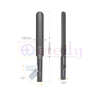
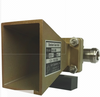
Small-element electric antennas are physical realizations of an ideal Hertzian dipole. These are some of the most important UWB antennas because they combine the compact size and omnidirectional pattern useful in a wide variety of consumer electronic and other applications. There are a variety of families of small-element electric antennas. These families include conical element antennas, planar conical antennas, bulbous antennas, and planar bulbous antennas. Electric antennas may be thought of as voltage driven and have predominantly electric near fields. This section will address some general principles of small-element electric antenna design.
Conical antennas are among the oldest of UWB small-element electric antennas having been pioneered by Lodge in the 1890s. The conical antenna family includes biconical dipoles, "monocone" monopoles, and discone antennas. The electromagnetics of conical elements were examined by Schelkunoff and others in the 1930s. Now, biconicals are a standard topic in most antenna textbooks [3], Also, UWB application of these antennas is an area of current interest [4]. This section will address biconical, monocone, and discone antennas, and discuss how to construct conical elements.
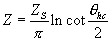
In the limit of an infinitely long biconical element, the impedance becomes
| (6.1) | |
where Z S = 376.7 ? is the impedance of free-space and ? hc is the half-angle of the bicone. A half-angle in the neighborhood of 67 yields a 50 ? match. Infinitely long biconical elements are difficult to build. The challenge for an...