The Art and Science of Ultrawideband Antennas

Hertz introduced reflector antennas in the 1880s. Figure 1.3 shows a sketch of a parabolic reflector Hertz used in his pioneering experiments. A reflector antenna relies on a quasioptical reflection of energy from a reflector. Like horn antennas, reflector antennas tend to be relatively large, directional, high-gain antennas. This section addresses some of the simplest and easy to implement UWB reflector antennas, including planar, corner, and parabolic cylinder reflectors.
A planar reflector is at once the simplest and yet most practical UWB reflector design [168]. Few commercial applications can tolerate an antenna protruding from an enclosure. If instead the antenna is conformal to the enclosure, using the enclosure as a back reflector, a more compact antenna structure may be feasible. Of course, no antenna can radiate through a conducting enclosure. The conducting enclosure planar reflector serves to concentrate the radiated and received signals to the antenna side of the planar reflector.
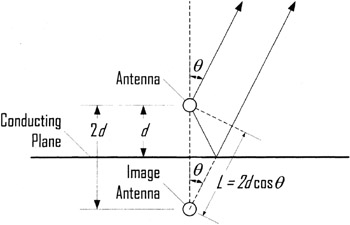
To model this configuration, consider an antenna a distance d from a conducting plane. The effective origin of the reflected signal is an image antenna a distance d below the conducting plane. Figure 6.64 shows the geometry of this configuration. A signal from the image must travel an excess path length:
| (6.5) | |
Thus, the reflected signal is subject to a delay:
| (6.6) | |
A composite signal from a planar reflector is a combination of a direct signal with...