The Art and Science of Ultrawideband Antennas

6.5: HORN ANTENNAS

6.5 HORN ANTENNAS

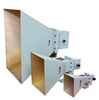
Originally introduced by Bose in the 1890s, a horn antenna is a flared or tapered transmission line designed to transmit and receive electromagnetic energy in one or more particular directions. Bose's original conical and pyramidal horn antennas (or "collecting funnels") follow simply from acoustical analogy. For decades after Bose's pioneering work, frequencies remained low and wavelengths long, rendering horn antennas impractical. With advances in microwave RF technology around the time of World War II, frequencies became high enough and wavelengths short enough for reasonable sized horn antennas to be practical again. Katzin, King, and others rediscovered Bose's designs and extended them to even higher levels of performance.

Horn antennas tend to be relatively large, often a wavelength or more in dimension at a typical operating frequency. These large apertures lead horn antennas to be directional with relatively high gains. The usual trade-off between directionality and field of view applies. Horn antennas will be able to transmit and receive signals very well (with high gain) but only over a limited field of view. The higher the gain, the narrower the field of view. Thus, horn antennas are typically used only in point-to-point links where a narrow field of view is not a liability. Alternatively, horn antennas may be used in an array with each horn providing coverage of a particular desired sector.

This section discusses conical plate horn antennas, one of the most basic and best understood horn designs. Then, this section addresses proper termination of horns. Planar...

UNLIMITED FREE
ACCESS
TO THE WORLD'S BEST IDEAS

SUBMIT
Already a GlobalSpec user? Log in.

This is embarrasing...

An error occurred while processing the form. Please try again in a few minutes.

Customize Your GlobalSpec Experience

Category: Horn Antennas
Finish!
Privacy Policy

This is embarrasing...

An error occurred while processing the form. Please try again in a few minutes.