The Art and Science of Ultrawideband Antennas

Small-element magnetic antennas are physical realizations of an ideal Hertzian magnetic dipole. These antennas involve one or more current loops. An ideal Hertzian electric dipole provides an omnidirectional vertical polarization pattern, while an ideal Hertzian magnetic dipole yields an omnidirectional horizontal polarization pattern. Magnetic antennas may be thought of as current driven and have predominantly magnetic near fields. Since electric fields tend to couple more strongly to nearby objects, magnetic antennas are better suited for embedded applications. A partial overview of UWB magnetic antennas has been presented elsewhere [88]. There is a variety of families of small-element electric antennas. These families include large current radiators (LCRs), monoloops, loops, and slot antennas. This section will discuss each of these families in turn.
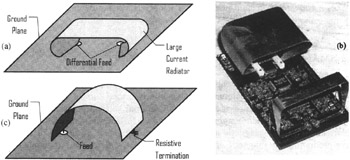
Harmuth pioneered the LCR antenna in the early 1980s [89], [90], [91]. An LCR antenna is ideally a uniformly distributed current sheet whose return currents are shielded by a ground plane [see Figure 6.41(a)]. Thus, an LCR antenna requires a differential feed. This antenna has some difficulties and shortcomings.