The time average of a function, u, is denoted by triangular brackets and defined as follows:
| (A.1) | 
|
where 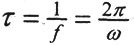 is the period. Time-average analysis is simplified by neglecting the effects of retardation
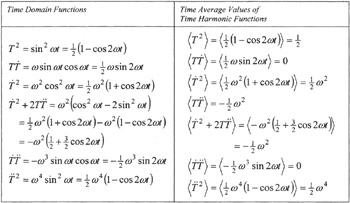
 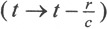 . This neglect makes calculations easier but is part of the way in which time average analysis tends to obscure the physical behavior of the electromagnetic fields. Table A.1 presents a variety of time functions relevant to the present analysis of the harmonic dipole and shows the results of the time-averaging process.
Table A.1: Harmonic Time Domain Functions | |
The radial component of the time-average harmonic Poynting vector is:
| (A.2) | 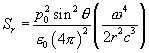
|
and the angular component of the time average harmonic Poynting vector is:
| (A3) | 
|
The time average time domain harmonic energy density becomes:
| (A.4) | 
|
for the electric field energy, and
| (A.5) | 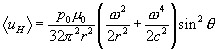
|
for the magnetic field energy. Expressing these results in terms of wave number 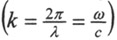 , the electric energy density is
| (A.6) | 
|
and the magnetic energy density is
| (A.7) | 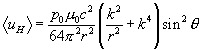
|
Noting that  , the propagating, or radiation, portion of the energy density is
| (A.8) | 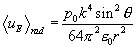
|
for the electric energy and:
| (A.9) | 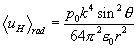
|
for the magnetic energy. The radiation energy is equally divided between electric and magnetic energy.
The traditional division of energy into propagating radiation energy and fixed reactive energy has a significant conceptual difficulty. Assume the electric field can be broken up into a reactive and radiation term:
| (A.10) | 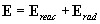
|
Then, the electric field energy is
| (A.11) | 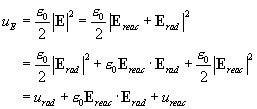
|
Lumping the cross-term into the reactive field energy leads to the unsatisfying result that the reactive...
Copyright Artech House, Inc. 2005 under license agreement with Books24x7

 TABLE OF CONTENTS