2006 ASHRAE Handbook: Refrigeration, Inch-Pound Edition

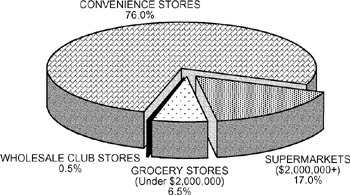
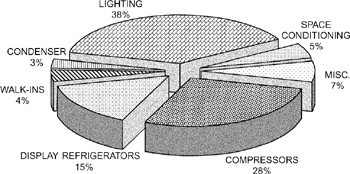
In the United States, almost 200,000 retail food stores operate their refrigeration systems around the clock to ensure proper merchandising and safety of their food products. Figure 1 shows that supermarkets and convenience stores make the largest contribution to this total (Food Marketing Institute 2004). In U.S. retail food stores, refrigeration consumes about 2.3% of the total electricity consumed by all commercial buildings (EIA 2003). As shown in Figure 2, refrigeration accounts for roughly 50% of the electric energy consumption of a typical supermarket (A.D. Little 1996). Supermarkets and grocery stores have one of the highest electric usage intensities in commercial buildings, at 43 kWh/ft 2 per year. Use for larger supermarkets with long operating hours has been measured at 70 kWh/ft 2 per year (Komor et al. 1998).
The modern retail food store is a high-volume sales outlet with maximum inventory turnover. The Food Marketing Institute defines a supermarket as any full-line self-service grocery store with an annual sales volume of at least $2 million (Food Marketing Institute 2004). These stores typically occupy approximately 50,000 ft 2 and offer a variety of meat, produce, and groceries. A new category of supermarkets, called supercenters, incorporates...