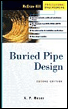
Buried Pipe Design, 2nd Edition

Underground conduits have served to improve people's standard of living since the dawn of civilization. Remnants of such structures from ancient civilizations have been found in Europe, Asia, and even the western hemisphere, where some of the ancient inhabitants of South and Central America had water and sewer systems. These early engineering structures are often referred to as examples of the art of engineering. Nevertheless, whether art or science, engineers and scientists still stand amazed at these early water and sewer projects. They seem to bridge the gap between ancient and modern engineering practice. The gap referred to here is that period known as the "dark ages" in which little or no subsurface construction was practiced a time when most of the ancient "art" was lost.
Today, underground conduits serve in diverse applications such as sewer lines, drain lines, water mains, gas lines, telephone and electrical conduits, culverts, oil lines, coal slurry lines, subway tunnels, and heat distribution lines. It is now possible to use engineering science to design these underground conduits with a degree of precision comparable with that obtained in designing buildings and bridges. In the early 1900s, Anson Marston developed a method of calculating the earth load to which a buried conduit is subjected in service. This method, the Marston load theory, serves to predict the supporting strength of pipe under various installation conditions. M. G. Spangler, working with Marston, developed a theory for flexible pipe design. In addition, much testing and research have produced quantities of...