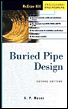
Buried Pipe Design, 2nd Edition

Chapter 5 deals with various generic rigid pipe products. For each product, selected standards and material properties are listed. The standards are from standard organizations such as the American Water Works Association (AWWA) and American Society for Testing and Materials (ASTM). Actual design examples for the various products are given in this chapter.
Asbestos-cement (AC) pipes are available for both gravity and pressure applications (see Tables 5.1 and 5.2). Because of the health risks associated with the handling of asbestos, AC pipe production in the United States has come to a complete halt. It is still produced in some countries and is available in some parts of the United States. This product has some flexibility, especially for lower classes (thinner walls). However, it is generally considered to be a rigid pipe product; therefore, the rigid pipe design method should be used for AC pipe installations.
| Modulus of elasticity | 3.0 10 6 lb/in 2 |
| Tensile strength | 3000 4000 lb/in 2 |
| Shear strength | 4000 lb/in 2 across pipe axis |
| Modulus of rupture (MR) | 5000 6000 lb/in 2 (bending strength in crush) |
| Compressive strength | 7000 lb/in 2 |
| Thermal conductivity | K = 5.5 (Btu in)/(h F ft 2), 4 when perfectly dry |
| Thermal coefficient of expansion | 4 5 10 -6 in/(in/ F) |
| Specific heat | 0.27 Btu/(lb F) @ 212 F |
| Moisture coefficient of expansion | 1.5 2.0 10 -5 in/(in/% moisture change) (moisture content is 6 to 7% for normal atmospheric conditions and 15 to 20% for... |