Carrier Grade Voice Over IP, Second Edition

SIP is a signaling protocol that handles the setup, modification, and tear-down of multimedia sessions. SIP, in combination with other protocols, is used to describe the session characteristics to potential session participants. Although strictly speaking, SIP is written such that the media to be used in a given session could use any transport protocol, the media will commonly be exchanged using the Real-Time Transport Protocol (RTP) as the transport protocol.
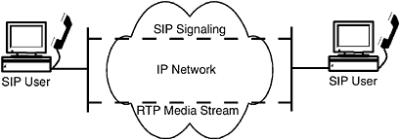
It is likely that SIP messages will pass through some of the same physical facilities as the media to be exchanged. SIP signaling should be considered separately from the media itself, however. Figure 5-2 shows the logical separation between signaling and session data. This separation is important, because the signaling may pass via one or more proxy or redirect servers while the media stream itself takes a more direct path. This approach can be considered somewhat analogous to the separation of signaling and media already described for H.323.
SIP defines two basic classes of network entities: clients and servers. Strictly speaking, a client (also known as a user agent client) is an application program that sends SIP requests. A server is an entity that responds to those requests. Thus, SIP is a client-server protocol. VoIP calls using SIP are originated by a client and terminated at a server. A client may be found within a user's device, which could be a PC with a headset...