Carrier Grade Voice Over IP, Second Edition

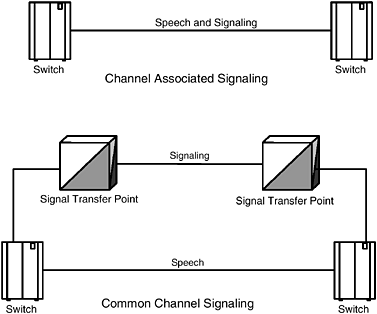
For a long time, signaling in circuit-switched networks was such that the signaling related to a particular call followed the same path as the speech for that call. This approach is known as Channel Associated Signaling (CAS), and the technique is still widely deployed today. Examples include the R1 Multifrequency (MF) signaling used in North America and the R2 Multifrequency Compelled (MFC) signaling used in many other countries. Although it is still widely used in circuit-switched networks, CAS is considered old technology. The prevailing technology in newer circuit-switched networks is Common Channel Signaling (CCS).
CCS involves the use of a separate transmission path for call signaling compared to the bearer path for the call itself, as shown in Figure 7-1. This separation enables the signaling to be handled in a different manner to the call itself. Specifically, other nodes in the network may analyze the signals and take action based on the content of the signals, without needing to be involved in the bearer path. Furthermore, CCS enables signaling messages to be exchanged in cases where no call is to be established at all. Imagine, for example, dialing a star-code to activate some feature. In such a scenario, the local switch might communicate with a service node to activate the feature in the network without actually establishing a call to the service node.
The standard for CCS todayis Signaling System 7 (SS7). Various versions of it are deployed all...