Carrier Grade Voice Over IP, Second Edition

Usage of SDP with SIP

SIP and SDP make a wonderful partnership for the transmission of session information. SIP provides the messaging mechanisms for the establishment of multimedia sessions and SDP provides a structured language for describing those sessions. The message body in SIP, identified by the entity headers, provides a neat slot where SDP can be used. It is this usage that this section will discuss.

SIP uses SDP in an offer/answer model. The initiator of a session offers a selection of media formats to be used in the session. The receiver of the offer either rejects the offer completely or selects those media formats that have been offered and which the responder is willing to accept. If the responder agrees to participate in the session, then the response to the initial offer (a SIP INVITE) will include a message body of the same form as the received message body, with an indication as to the acceptance or rejection of each of the offered media types.

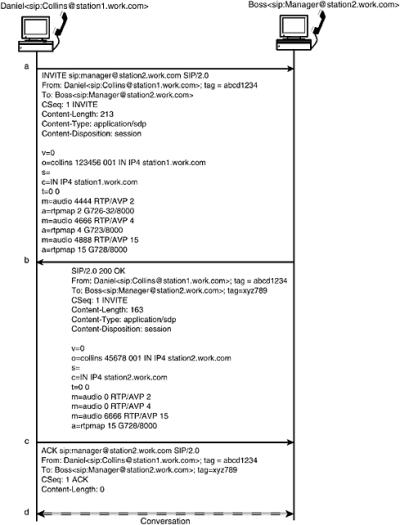
If we take the example outlined in Figure 5-9 and assume that Collins can support voice coded according to G.726, G.723.1, or G.728 and we assume that Boss can only support voice coded according to G.728, then the messages would appear as shown in Figure 5-15. For avoidance of clutter, a number of header fields (such as Via:) have been omitted, as has the 180 (Ringing) response. These would be included according to Figure 5-9.


Figure 5-15: SDP inclusion in SIP...

UNLIMITED FREE
ACCESS
TO THE WORLD'S BEST IDEAS

SUBMIT
Already a GlobalSpec user? Log in.

This is embarrasing...

An error occurred while processing the form. Please try again in a few minutes.

Customize Your GlobalSpec Experience

Category: Automated Voice Answering Systems
Finish!
Privacy Policy

This is embarrasing...

An error occurred while processing the form. Please try again in a few minutes.