Carrier Grade Voice Over IP, Second Edition

Building upon the information provided already in this chapter, a number of examples are provided to demonstrate how SIP messages might appear in various situations. We do not explain every possible option in these examples, just some of the most common occurrences. For details of all options available, the reader is referred to RFC 3261.
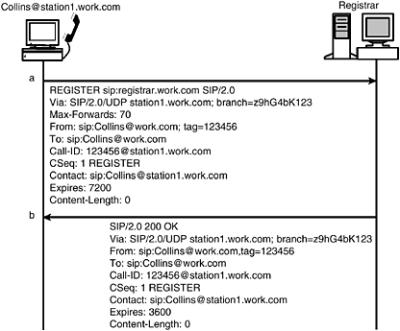
The very first request issued by a client is likely to be REGISTER, because this is the request that provides the server with an address at which the user can be reached for SIP sessions. The REGISTER request is somewhat similar to the Registration Request between a terminal and a gatekeeper in H.323.
Figure 5-8 shows an example registration scenario. In this scenario, Collins has logged in to host station1.work.com. This causes a REGISTER request to be sent to the local registrar. The Via: header field contains the path taken by the request so far, which requires that the originating client insert its own address in this field. Note the format of the Via: header and in particular the fact that it specifies the transport being used. The default is the User Datagram Protocol (UDP). Note also that the Via: header contains a branch parameter. The purpose of the branch parameter is discussed later when we describe the operation of proxy servers.
The From: header field indicates the address of the individual who has initiated the registration. The To:...