Change-Based Test Management: Improving the Software Validation Process

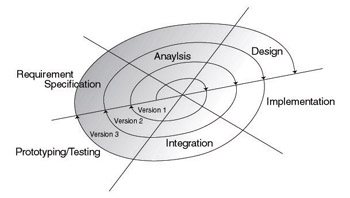
In the waterfall model discussed in Chapter 1, validation occurs at the end of the cycle. In the spiral model of the software development cycle, some degree of validation occurs after an iteration of the cycle. The spiral model shown in Figure 3.1 relies on prototypes and feedback to produce an evolving set of requirements while the waterfall method requires completion of one phase before moving onto the next phase (Boehm 1988). You should note that the spiral model is a superset of the waterfall model with each revolution of the spiral being an iteration of the waterfall.
The software validation cycle is a subset of the development cycle. A common and costly misconception is that software validation only occurs at the end of the development cycle. This should not be the case.
Involving validation earlier in the cycle leads to a better understanding of the product and the defect tendencies. In any development model, validation has a place.
Another model that is quickly gaining popularity is the Extreme Programming model (XP). XP focuses on communication, simplicity, and feedback. XP is very useful when you are dealing with changing requirements because it allows for quick momentum shifts. Testing is the heart of the process and you write the tests before the code. By doing this, the developers write clean and simple code, as well as creating a test suite as the program progresses. The ultimate goal of XP is to create a number...