Change-Based Test Management: Improving the Software Validation Process

Chapter 7: Measuring: How Well Are You Doing It?

Overview

Now that you have completed your testing, it is time to look at the results and determine how well you executed the validation plan. You examine several aspects of your testing to measure effectiveness as well as risk management. This is an important phase of the validation cycle because it allows you to determine how comfortable you are with the existing quality of the product, as well as identifying areas for improvement. The strengths and weaknesses of your team serve as inputs to the feedback phase and allow you to increase the effectiveness of your validation effort in future cycles.

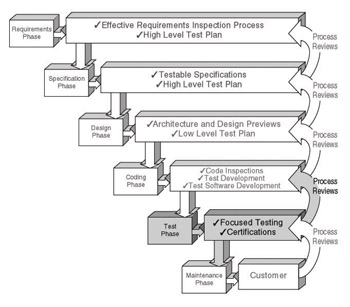
The measuring phase mainly involves the validation team. At this point in the product cycle, development is really only implementing defect fixes and there should be no new features inserted into the code. The majority of the work done by validation is checking the defect fixes to ensure their correctness and evaluating the success of the validation cycle. Figure 7.1 shows the measuring phase. Note that it occupies the same region of the Framework of Quality as the execution and monitoring phase.


Figure 7.1: The Measuring Phase

CBTM relies heavily on the measuring phase, because this is where most of the data is collected. Code coverage numbers and delta reports are the heart of CBTM, so take special care to ensure this data is accurate. During this phase you evaluate the coverage numbers you collected during the execution phase in order to determine the overall coverage of your product.

UNLIMITED FREE
ACCESS
TO THE WORLD'S BEST IDEAS

SUBMIT
Already a GlobalSpec user? Log in.

This is embarrasing...

An error occurred while processing the form. Please try again in a few minutes.

Customize Your GlobalSpec Experience

Category: Product and Component Testing Services
Finish!
Privacy Policy

This is embarrasing...

An error occurred while processing the form. Please try again in a few minutes.