Civil Engineering Survey Review, 3ed
Including many examples and problems with solutions, this detailed guide will help to prepare for the Special Civil Engineer (CE) Exam which is required for all civil engineer examinees.
| Symbols | |
|---|---|
| PI | Point of Intersection. |
| I | Intersection angle at PI (= Central angle). |
| T | Tangent distance from BC to PI (or from EC to PI). |
| E | External distance, distance from PI to midpoint of curve. |
| M | Middle ordinate, distance from midpoint of curve to midpoint of long chord. |
| L | Length of curve, distance from BC to EC along the arc. |
| BC | Beginning of curve. (also termed PC) |
| EC | End of Curve. (also termed PT) |
| O | Radius Point (center of radius). |
| LC | Length of the Long Chord. |
| R | Radius of the curve |

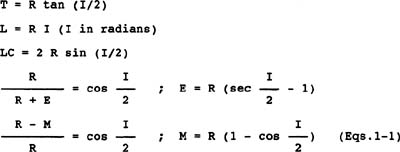
There are two types of horizontal curves: Circular Arcs and Spirals. A circular arc connecting two tangents is a simple curve. Easement curves are used to lessen the sudden change in curvature at the junction of a tangent and a circular curve.
A spiral makes a good easement curve.
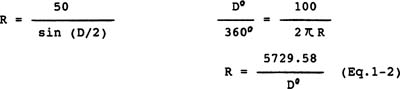
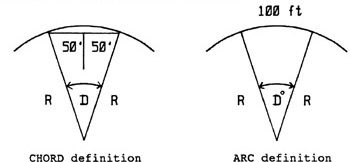
There are two definitions of Degree of Curve :
The CHORD definition is used in railroad practice.
The ARC definition is used for highway work.
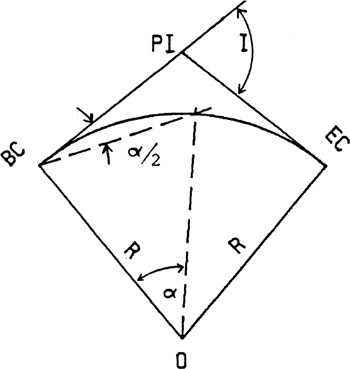
The DEFLECTION ANGLE formed by a tangent and chord is equal to one-half the angle of the intercepted arc. This is illustrated in the following figure:
Given a curve with a radius R = 350 ft, calculate the deflections to each full station and the E.C. (End of Curve). The B.C. (Beginning of Curve) is station 12+13.22
| Station | Deflection |
|---|---|
| B.C. 12+13.22 | |
| 13+00 |
|
| 14+00 |
|
| 15+00 |
|
| E.C. 15+19.96 |
|
Solutions:
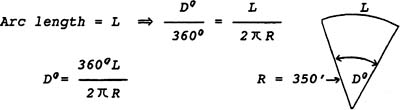

The deflections to each station:
| Station |
|---|

 TABLE OF CONTENTS