Civil Engineering Survey Review, 3ed
Including many examples and problems with solutions, this detailed guide will help to prepare for the Special Civil Engineer (CE) Exam which is required for all civil engineer examinees.
| DMD | Method |
The area of a closed traverse can be calculated by the Double-Meridian Distance (DMD) method. Before calculating the area, the traverse should be checked and adjusted for closure.
The meridian distance of a traverse course is the perpendicular distance from the center point of the course to the reference meridian. To ease the signs problem, the reference meridian usually is placed through the most westerly traverse station. The following rules can be applied in calculating DMD:
DMD of the first course = departure of the first course.

DMD of the last course = (-) departure of the last course.
The area is calculated by the following equation:

and 1 acre = 43,560 ft 2, 1 mile = 5,280 ft.
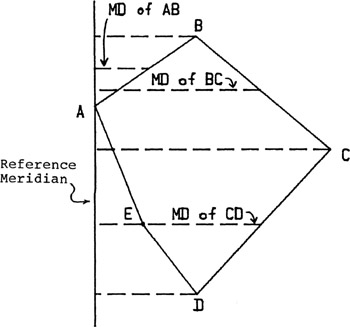
An example for the DMD method is illustrated as follows:
You are provided, by an individual authorized to practice land surveying, the following property description:
Beginning at most westerly corner of Lot 1, Tract No. 2 as shown below.
| Thence N 55 37 ?E | 567.34 feet; |
| thence S 49 38 ?E | 810.76 feet; |
| thence S 43 26 ?W | 922.75 feet; |
| thence N 39 22 ?W | 411.72 feet; |
| thence N 18 53 ?W | 588.16 feet; |
| to the point of beginning. |
REQUIRED
Calculate the area ABCDEA.
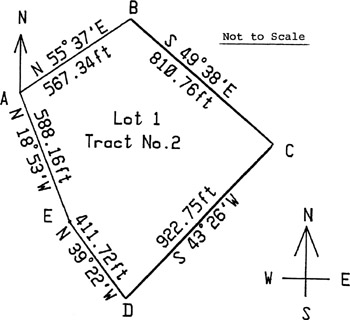
Solution:
Check the sum of the interior angles as in example 3-3.
Calculate the area ABCDEA by the DMD method
| Line | Bearing | Distance | Latitude (cos) | Departure (sin) | Correction | |
|---|---|---|---|---|---|---|
| L. | D. | |||||
| AB | N 55 37 ?E | 567.34 | 320.39 | 468.21 | 0. | ?0.01 |
| BC | S 49 38 |

 TABLE OF CONTENTS