Communications Receivers: DSP, Software Radios, and Design, 3rd Edition

7.10: Frequency Standards

7.10 Frequency Standards

Frequency standards are the heart of frequency synthesizers and local clock timing for most modern receivers. The accuracy of the required standard depends on the application. In most cases, sufficient accuracy for radio receiver frequency determination can be obtained from quartz crystal oscillators. However, in some applications greater precision may be required than can be maintained over a long time by even the best available quartz standards. In this case, atomic frequency standards can be used. In these standards, an atomic resonance is used as the primary standard and a stable crystal oscillator is locked to the atomic standard. There are two atomic standards available at present, the cesium atomic beam type and the rubidium gas cell type. The cesium atomic beam type uses a true atomic resonance and is a primary standard. This type of unit is used by standards organizations, and is generally quite costly. The rubidium gas cell also employs an atomic reso- nance, but the frequency depends to some extent on the gas mixture and the gas pressure in the cell. For precise results, it must be calibrated from time to time against a cesium standard. However, its long-term stability is about two orders of magnitude better than that of the best quartz crystal oscillator standards. It is less costly and more easily portable than the cesium atomic standard.


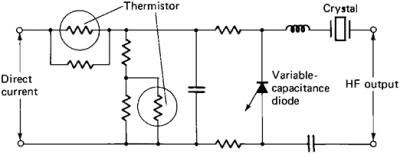
Figure 7.124: Temperature-compensation circuit containing one variable-capacitance diode and two thermistors. ( After [7.36].)

Depending on performance and cost requirements, we...

UNLIMITED FREE
ACCESS
TO THE WORLD'S BEST IDEAS

SUBMIT
Already a GlobalSpec user? Log in.

This is embarrasing...

An error occurred while processing the form. Please try again in a few minutes.

Customize Your GlobalSpec Experience

Category: Time and Frequency Standards
Finish!
Privacy Policy

This is embarrasing...

An error occurred while processing the form. Please try again in a few minutes.