Computer Arithmetic Algorithms, Second Edition
Chapter 3: Sequential Algorithms for Multiplication and Division

This chapter presents the basic sequential algorithms for multiplication, division, and square root extraction. Algorithms for high-speed multiplication are described in Chapter 6. Chapters 7, and 8 include algorithms for fast division and high-speed calculation of square roots.

3.1 Sequential Multiplication

Let the multiplier and multiplicand be denoted by X and A, respectively, with the following sequences of digits:


where x n ?1 and a n ?1 are the sign digits in either the signed-magnitude or the complement methods.

The sequential algorithm for multiplication consists of n ?1 steps where in step j the multiplier bit x j is examined and the product x j A is added to the previously accumulated partial product, denoted by P (j). The appropriate expression for this recursive procedure is


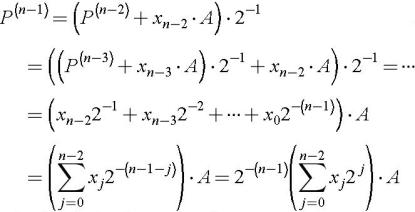
where in the first step p (0)=0. Multiplying the sum (p (j) +x j A) by 2 ? 1 shifts it by one position to the right, to align p ( j +1) before adding the next product x j +1 A. This alignment is necessary, since the weight of x j +1 is double that of x j. To prove that the above procedure calculates the product of A and X, we repeatedly substitute into the recursive Equation (3.1), yielding


If both operands are positive (i.e., x n ?1= a n ?1=0), the product U is obtained from


The result is a...

UNLIMITED FREE
ACCESS
TO THE WORLD'S BEST IDEAS

SUBMIT
Already a GlobalSpec user? Log in.

This is embarrasing...

An error occurred while processing the form. Please try again in a few minutes.

Customize Your GlobalSpec Experience

Category: Wireways
Finish!
Privacy Policy

This is embarrasing...

An error occurred while processing the form. Please try again in a few minutes.