Computer Arithmetic Algorithms, Second Edition
5.10: Hybrid Adders

5.10 Hybrid Adders

Hybrid adders are adders which use a combination of two or more of the previously described methods for addition. A common approach to the design of hybrid adders is to choose one method for carry propagation and another method for sum calculation. The two hybrid adders presented in this section combine some variation of a carry-select adder for calculating the sum and a modified Manchester adder for carry propagation. Both divide the operands into groups of equal size 8 bits each.

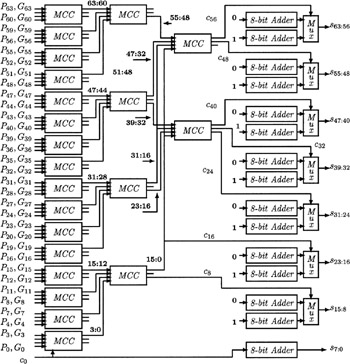
The first hybrid adder [20] employs the carry-select method for calculating the sum for each group of 8 bits separately as shown in Figure 5.16. The group carry-in signal that selects one out of the two sets of sum bits is not generated in a ripple-carry manner as shown in Figure 5.13. Instead, the carries into the 8-bit groups are generated by a carry-look-ahead tree as proposed in [1]. In the case of a 64-bit adder these are c 8, c 16, c 24, c 32, c 40, c 48 and c 56 (see Figure 5.16).


Figure 5.16: A schematic diagram of a 64-bit hybrid adder (20).

The structure of a carry-look-ahead tree for generating these carries would be similar but not necessarily identical to that shown in Figure 5.8. The differences between such structures stem from variations in the blocking factor at each level of the tree and the exact implementation of a module for calculating the fundamental carry...

UNLIMITED FREE
ACCESS
TO THE WORLD'S BEST IDEAS

SUBMIT
Already a GlobalSpec user? Log in.

This is embarrasing...

An error occurred while processing the form. Please try again in a few minutes.

Customize Your GlobalSpec Experience

Category: Logic Adders
Finish!
Privacy Policy

This is embarrasing...

An error occurred while processing the form. Please try again in a few minutes.