Design of Wood Structures: ASD, Fifth Edition

6.2: Bending

6.2 Bending

In discussing the strength of a wood beam, it is important to understand that the bending stresses are parallel to the length of the member and are thus parallel to the grain of the wood. This is the common beam design problem (Fig. 6.1a), and it is the general subject of this section. See Example 6.1.


Figure 6.1: Bending stress is parallel to grain in the usual beam design problem.

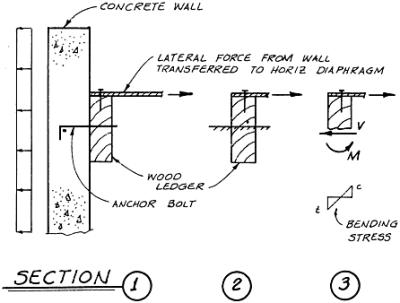
Occasionally, however, bending stresses across the grain (Fig. 6.1b) are developed, and the designer needs to recognize this situation. It has been noted previously that wood is relatively weak in tension perpendicular to grain. This is true whether the cross-grain tension stress is caused by a direct tension force perpendicular to grain or by loading that caused cross-grain bending. Cross-grain tension should generally be avoided.

EXAMPLE 6.1 Bending in Wood Members

Longitudinal Bending Stresses ( Parallel to Grain )

Ordinarily, the bending stress in a wood beam is parallel to the grain. The free-body diagram (FBD) in Fig. 6.1a shows a typical beam cut at an arbitrary point. The internal forces V and M are required for equilibrium. The bending stress diagram indicates that the stresses developed by the moment are longitudinal stresses, and they are, therefore, parallel to grain. Bending is shown about the strong or x axis of the member.

Cross-Grain Bending Not Allowed

Section 1 in Fig. 6.1b shows a concrete wall connected to a wood horizontal...

UNLIMITED FREE
ACCESS
TO THE WORLD'S BEST IDEAS

SUBMIT
Already a GlobalSpec user? Log in.

This is embarrasing...

An error occurred while processing the form. Please try again in a few minutes.

Customize Your GlobalSpec Experience

Category: Mechanical Testing Services
Finish!
Privacy Policy

This is embarrasing...

An error occurred while processing the form. Please try again in a few minutes.