Design of Wood Structures: ASD, Fifth Edition

The deflection limits for wood beams required by the IBC and the additional deflection limits recommended by AITC are discussed in Sec. 2.7. Actual deflections for a trial beam size are calculated for a known span length, support conditions, and applied loads. Deflections may be determined from a traditional deflection analysis, from standard beam formulas, or from a computer analysis. The actual (calculated) deflections should be less than or equal to the allowable deflections given in Chap. 2. See Example 6.15.
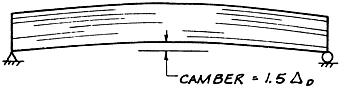
EXAMPLE 6.15 Beam Deflection Criteria and Camber
Actual Deflection
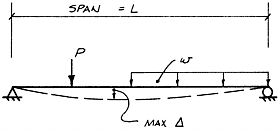
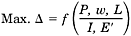
The maximum deflection is a function of the loads, type of span, moment of inertia, and modulus of elasticity:
where <i class="emphasis">E<span class="unicode">?</span> </i>= allowable (i.e., adjusted) modulus of elasticity <span class="inlinemediaobject"><img alt="Image from book"> border="0"> height="15"> id="IMG_539"> src="https://images.books24x7.com/bookimages/id_15157/p30001e14g6_350003vpp.png"> title=""> width="120"></span>
Other terms for beam deflection analysis are as normally otherwise defined.
The adjustment factors for evaluating the allowable (i.e., adjusted) modulus of elasticity are introduced in Chap. 4. The factors and typical values for frequently encountered conditions are
<i class="emphasis">E</i> = tabulated modulus of elasticity = <i class="emphasis">E</i><sub<i class="emphasis">x</i></sub> for usual case of bending about strong axis<i class="emphasis">C</i><sub<i class="emphasis">M</i></sub> = wet service factor (<a class="chapterjump"> href="portalcontent.asp?bkid=15157&destid=445#445"> target="_parent">Sec. 4.14</a>) = 1.0 for dry-service conditions as in most covered structures. Dry-service conditions are defined as MC <span class="unicode">?</span>