Design of Wood Structures: ASD, Fifth Edition

One of the three design criteria discussed in the previous sections (bending, shear, and deflection) will determine the required size of a wood beam. In addition, consideration must be given to the type of lateral support that will be provided to prevent lateral instability. If necessary, the bending stress analysis will be expanded to take the question of lateral stability into account. With some practice, the structural designer may be able to tell which of the criteria will be critical by inspection.
The sequence of the calculations used to design a beam has been described in the above sections. It is repeated here in summary.
For many beams the bending stress is the critical design item. Therefore, a trial beam size is often developed from the bending stress formula
A trial member is chosen which provides a furnished section modulus S that is greater than the required value. Because the magnitude of the size factor C F or the volume factor C V is not definitely known until the size of the beam has been chosen, it may be helpful to summarize the actual versus allowable bending stresses after a size has been established:
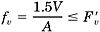
After a trial size has been established, the remaining items (shear and deflection) should be checked. For a rectangular beam, the shear is checked by the expression
In this calculation a reduced shear V ? can be substituted for V, and
becomes the computed shear in place...