Design of Wood Structures: ASD, Fifth Edition

When a member functions as a beam, a portion of the cross section is stressed in compression and the remaining portion is stressed in tension. If the compression zone of the beam is not braced to prevent lateral movement, the member may buckle at a bending stress that is less than the allowable stress defined in Sec. 6.2. The allowable bending stress described in Sec. 6.2 assumed that lateral torsional buckling was prevented by the presence of adequate bracing.
The bending compressive stress can be thought of as creating an equivalent column buckling problem in the compressive half of the cross section. Buckling in the plane of loading is prevented by the presence of the stable tension portion of the cross section. Therefore, if buckling of the compression side occurs, movement will take place laterally between points of lateral support. See Example 6.6.
EXAMPLE 6.6 Lateral Buckling of Bending Member
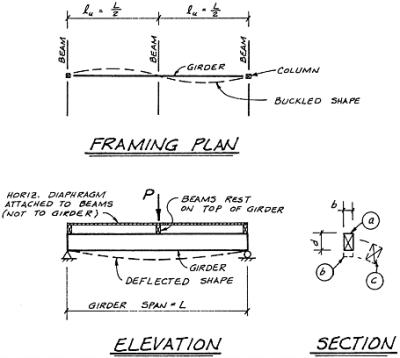
Unlike the beam in Example 6.3, the girder in Fig. 6.6 does not have full lateral support.
The distance between points of lateral support to the compression side of a bending member is known as the unbraced length l u of the beam. The beams that frame into the girder in Fig. 6.6 provide lateral support of the compression (top) side of the girder at a spacing of l u = L/2.
It is...