Development of a New Material: Monolithic Ti4O7 Ebonex Ceramic
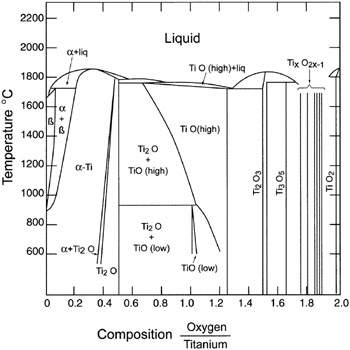
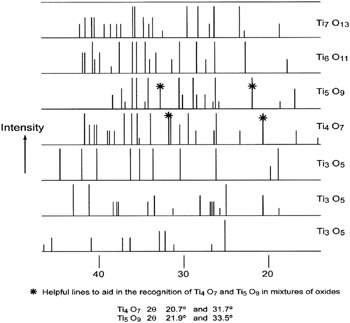
Figure 2 1, assembled on the basis of many contributions to the literature, illustrates the titanium-oxgyen equilibrium diagram. There are many oxides, (see Table 2 1). Principal X-ray diffraction lines for several of the oxides are shown in Fig. 2 2.
| Compound | x in TiO x | Structure | X-ray density |
|---|---|---|---|
| TiO 2 | 2 | Rutile | 4.25 |
| Anatase | 3.89 | ||
| Ti 10O 19 | 1.9 | ||
| Ti 9O 17 | 1.89 | Triclinic | 3.75 |
| Ti 8O 15 | 1.875 | Triclinic | 3.84 |
| Ti 7O 13 | 1.857 | Triclinic | 3.9 |
| Ti 6O 11 | 1.833 | Triclinic | 4.0 |
| Ti 5O 9 | 1.8 | Triclinic | 4.31 |
| Ti 4O 7 | 1.75 | Triclinic | 4.32 |
| ?Ti 3O 5 | 1.67 | Monoclinic | 4.35 |
| Monoclinic | 4.24 | ||
| Monoclinic | 4.11 | ||
| Ti 2O 3 | 1.5 | Tetragonal | 4.585 |
| TiO | 1.0 | Hexagonal | 5.69 |
| Cubic | 5.82 | ||
| Monoclinic | 5.89 | ||
| Ti 2O | 0.5 | Hexagonal | 5.0 |
| Ti | 0 | Hexagonal | 4.5 |
In order better to appreciate aspects of this equilibrium diagram, an attempt will be made to describe the thinking about titanium and oxygen by those working on titanium at the time. Of some, it might be said that it was a permanent pre-occupation.
It had long been appreciated that titanium is in fact a most reactive metal, that owes its ambient temperature stability, in common with aluminium and several other valve metals , to...