Development of a New Material: Monolithic Ti4O7 Ebonex Ceramic

Early steam generating plant employed a principle known as electrode boiling. AC current is applied between two electrodes at a high frequency sufficiently high to prevent any Faradaic reaction from proceeding. Heat is generated by the IR voltage drop between electrodes. Usually 50Hz AC is used but some much higher frequency high current density systems have been developed for rapid sterilisation of foodstuffs. A particular attraction of electrode boiling over and above other methods is a safety factor. If the electrolyte boils dry, then no further current passes and hence over-heating is avoided. Electrode boiling has attraction for domestic appliances, and in one design, the electrodes did not face one another, but were inlaid side by side, on the floor of the kettle.
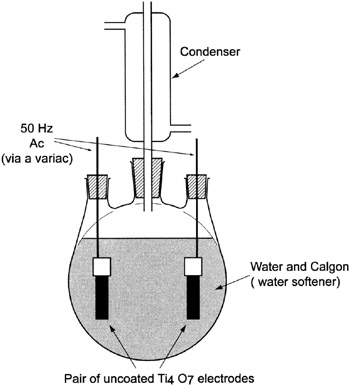
Not all materials are resistant to electrode boiling. Surprisingly the noble metal platinum succumbs to corrosion at 50Hz when used simply to boil water. Monolithic Ti 4O 7 behaves well under AC, possibly because the cathodic cycle is helpful in preventing any tendency to anodic passivation. In connection with electrode boiling, pairs of strip electrodes were used to boil water in a reflux apparatus (see Fig. 4 1). The testing was continued over many months without apparent deterioration of the electrodes.
The successful experiment described above, does not necessarily imply that monolithic Ti 4O 7 is a contender for commercial application,...