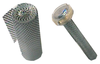
Development of a New Material: Monolithic Ti4O7 Ebonex Ceramic

When a new material becomes available, countless potential applications come to mind for its commercial exploitation. Manifestly, success or failure in a particular application depends upon the availability of the material in appropriate form. Many such early trials of Ebonex would now be well worth re-visiting, not only because the quality of the material has so greatly improved, but equally, because there is now a far better apppreciation of its properties and behaviour. There is little doubt that many new areas of application will be opened up, as non-porous forms become available.
As described in the introduction, there was a time when it seemed commercially viable to replace the massive lead-silver anodes used in electrowinning with a titanium-based product. One reason in particular, was the escalating price of silver, making it an attractive proposition to recover value latent in the silver content of the lead 1 2% silver anodes to set against the higher cost of titanium based anodes. As development of alternate anodes proceeded, the rising price of silver was exposed as fraudulent .the notorious attempt by Nelson Bunker Hunt to corner the world silver market. With the subsequent collapse in the price of silver, (and decades later, the price has never remotely approached its peak at that time) so the financial case for titanium-based electrodes has been devastated. The issue is compounded because recently developed lead alloys with lower silver content are now additional contenders for this market.
Nevertheless, the development work at the time...