Development of a New Material: Monolithic Ti4O7 Ebonex Ceramic

2.2: HOW TO PRODUCE Ti4O7?

2.2 HOW TO PRODUCE Ti 4O 7?

2.2.1 General Considerations

From thermodynamic considerations, (see the temperature composition equilibrium diagrams), titanium dioxide cannot be reduced directly to the metal via reductants such as hydrogen, carbon and carbon monoxide. At sufficiently elevated temperature, however, it is known such reductants can be used to make Ti 3O 5, possibly Ti 2O 3, but certainly down to a lower oxidation state than the Magneli series, including Ti 4O 7.

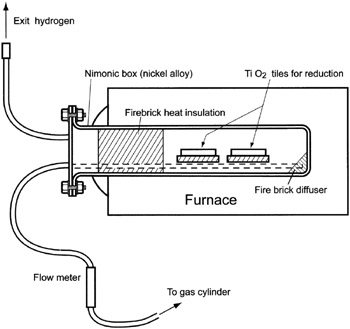
Because of the immediate availability of equipment, the first reduction of monolithic titania to Ti 4O 7 was carried out using hydrogen. The experimentation involved a Nimonic (nickel-base alloy) box as sketched in Fig. 2 3.


Fig. 2 3: Furnace arrangement for high temperature reduction of TiO 2 ceramic to monolithic Ti 4O 7.

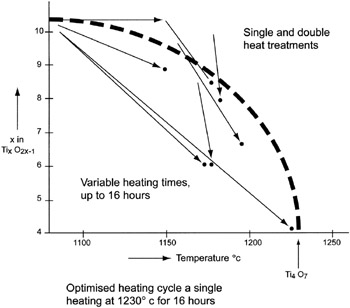
While the furnace into which the box fitted had a capability of 1500 C, the Nimonic material began to suffer significant oxidation above 1000 C. At the minimum temperature eventually found necessary to achieve Ti 4O 7 in reasonably short times hours rather than days (see Fig. 2 4), the Nimonic thinned to the point of perforation over 8 to 10 heating cycles and the repair/renewal of these boxes became a significant cost.


Fig. 2 4: Reduction of TiO 2 ceramic on heating in hydrogen at various temperatures.

Cylinder hydrogen was piped to the closed end of the box and into a porous fire brick to act as a kind of distributor for the...

UNLIMITED FREE
ACCESS
TO THE WORLD'S BEST IDEAS

SUBMIT
Already a GlobalSpec user? Log in.

This is embarrasing...

An error occurred while processing the form. Please try again in a few minutes.

Customize Your GlobalSpec Experience

Category: Refractory Cements and Raw Materials
Finish!
Privacy Policy

This is embarrasing...

An error occurred while processing the form. Please try again in a few minutes.