Digital Techniques for Wideband Receivers, Second Edition

Chapter 5: Fourier Transform-Related Operations

5.1 INTRODUCTION

In this chapter, the operations discussed will be related to the Fourier transform and especially to the discrete Fourier transform (DFT) or fast Fourier transform (FFT). Some of these operations are useful to receiver design and some of these techniques can improve the results of the FFT. The discussion includes zero padding, better localization of FFT peaks, digital convolution, parallel FFT operations to increase overall speed, performing real FFT by using complex FFT operations, and a phase sampling scheme to increase the bandwidth of the receiver.

5.2 ZERO PADDING [1, 2]

Zero padding is the addition of zeros at the end of a digital data string before the FFT is performed. For example, if 64 points of data are collected, usually a 64-point FFT is performed to obtain the frequency. However, one can add 64 zeros at the end of the data string and perform a 128-point FFT. Since zero padding does not add any new information, the resultant FFT form (i.e., the frequency resolution) does not change. For the 64 data points with 64 zeros, the number of output frequency components is doubled.

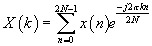
In general, suppose there are N data points x(0) to x( N - 1), and we add N zero points from x( N) to x(2 N - 1) and perform a 2 N-point DFT. The result will be

(5.1)

Note that the summation is from 0 to 2 N - 1 and the kernel is

UNLIMITED FREE
ACCESS
TO THE WORLD'S BEST IDEAS

SUBMIT
Already a GlobalSpec user? Log in.

This is embarrasing...

An error occurred while processing the form. Please try again in a few minutes.

Customize Your GlobalSpec Experience

Category: Data Acquisition Systems and Instruments
Finish!
Privacy Policy

This is embarrasing...

An error occurred while processing the form. Please try again in a few minutes.