Digital Techniques for Wideband Receivers, Second Edition

14.3: YULE-WALKER EQUATION [1-21]

14.3 YULE-WALKER EQUATION [1-21]

The linear prediction defined in (14.6) and (14.7) can be considered as a filter with noise u( n) as input and x( n) as output. This filter is shown in Figure 14.1. Figure 14.1(a) shows the overall function of the filter and Figure 14.1(b) shows the feedback circuit. The first step is to find the coefficients of the filter. If the input u( n) is assumed to be an unknown response, the signal x( n) can be predicted only approximately from a linearly weighted summation of the past terms. As a result, the linear prediction expression can be written as

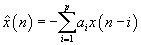
(14.8)

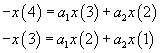
where represents the estimate of x( n). For simplicity, x( n) is used for in later discussion. Replacing x( n) by x( n - 1), x( n - 2), , x( n - p + 1), one can obtain a set of p linear equations. For example, if there are four data points x(1), x(2), x(3) and x(4), and p = 2, there will be two equations with constants a 1 and a 2. These equations can be written as

(14.9)

Since all the x( n) are known, theoretically, it is possible to determine the a values. This result will be equivalent to the Prony's method, which originates from a...

UNLIMITED FREE
ACCESS
TO THE WORLD'S BEST IDEAS

SUBMIT
Already a GlobalSpec user? Log in.

This is embarrasing...

An error occurred while processing the form. Please try again in a few minutes.

Customize Your GlobalSpec Experience

Category: IC Electronic Filters
Finish!
Privacy Policy

This is embarrasing...

An error occurred while processing the form. Please try again in a few minutes.