14.9 PRONY'S METHOD [3-5, 13, 35 40]
There are different ways to derive Prony's method. Only one approach will be presented in this section, which is based on Hildebrand [35]. Prony's method solves a particular set of simultaneous nonlinear equations, which must fit in a certain form. An input signal consisting of only sinusoidal waves can be written in the desired form. In order to simplify the discussion, a simple example will be used to illustrate the basic idea and then a general case will be presented.
Let us assume that the input signal contains two complex sinusoidal waves without noise. The signal can be written as
| (14.54) | 
|
where A 1 and A 2, f 1 and f 2, and ? 1, and ? 2 are the amplitude, the frequency, and the initial phase of the two signals, respectively. The amplitude and the frequency are of primary interests. The amplitudes and initial phases A 1 and ? 1 and A 2 and ? 2 can be combined into two unknowns. In order to solve for these unknowns, four equations are required. If these signals are digitized at t = 0, 1, 2, and 3, the results are
| (14.55) | 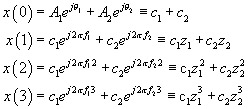
|
where
| (14.56) | 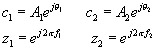
|
Prony developed a clever method to solve the above equation by converting this essentially nonlinear problem to a linear one. First, multiply the first three equations by a 2, a 1, and -1, respectively, where a 2


 TABLE OF CONTENTS