Digital Techniques for Wideband Receivers, Second Edition

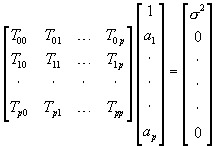
In (14.13), the R matrix is obtained from the autocorrelations with different lags. However, this is not the only way to form the R matrix. The data can be manipulated differently to obtain different results. In other words, the autocorrelation matrix is not the only approach to obtain the a i constants in (14.18). Some of the approaches can improve the quality of the spectrum estimation. In order to use other ways to adopt the input data, (14.19) is rewritten as
| (14.29) | |
This equation is identical to (14.19), except that the matrix T is used to replace R.
Different ways of generating the T matrix from the same input data can produce quite different results. Two different ways to obtain T will be discussed. Assume there are N input data points from x(0) to x( N - 1).
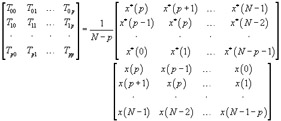
In this method the input data are related to matrix T as
| (14.30) | |
This matrix is not Toeplitz. Although a special recursive method can be developed for this approach, the Levinson-Durbin method does not apply directly. In this approach, all the elements in the T matrix contain the same number of terms from the data points.
If p = 1 and N = 3, the data are x(0), x(1), and x(2), and the T matrix is
| (14.31) | |
If p =...