Digital Techniques for Wideband Receivers, Second Edition

From the previous section, it is clear that when the wrong order in the Burg method is selected, the spectrum does not reflect the real input signal. If the order is too low, closely spaced frequencies cannot be detected. If the order is too high, spurious frequencies will be generated. Both situations cannot be tolerated in receiver designs. Thus, it is important to select the correct order of the linear model, but this is a difficult task.
One intuitive approach is to use the recursive approach to find the coefficients and monitor the prediction error. If the data can be truly described by a finite-order linear model, when the correct order is reached the error will either reach a minimum or stay constant. However, this approach may not work. The prediction error may not converge or change monotonically. As a result, there is no easily detected minimum.
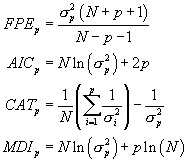
The four common methods to choose the order of the linear model are 1) the final prediction error ( FPE), 2) the Akaike information criterion ( AIC), 3) the criterion autoregression transfer ( CAT), and 4) the minimum description length ( MDL). The results of the four approaches are listed below.
| (14.52) | |
In order to obtain the p value, one of above equations will be minimized. For example, the AIC method determines the p value by minimizing AIC p. If the data do not fit an...