Discrete Algorithmic Mathematics, Third Edition
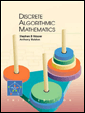
Written in a lively, clear style that talks to the reader, this book is unique for its emphasis on algorithmics and the inductive and recursive paradigms as central mathematical themes.
 TABLE OF CONTENTS
 The material in this chapter is not the real stuff of discrete mathematics, but rather material you need to have under your belt to do discrete mathematics. Some of it, like this section, is probably review. Some, like Section 0.3 (Growth Rates and Order Notation) is probably quite new. Some, like Section 0.6 (The Language and Methods of Reasoning) probably contains material you have mostly seen, but organized differently and with advice that may be fresh. In any event, you can read this chapter first, or read it later piecemeal as needed.
Sets provide a language for discussing discrete mathematics, or any mathematics. Set language is not exciting, but it is very useful.
A set is a collection of objects. They can be any objects, but for now the objects will mostly be numbers. For instance, the set A={7, 3} contains two things, the numbers 3 and 7. We write 3 ? A and say that 3 is a member or element of A. Order doesn t matter, so {7, 3}={3, 7}.
To say that 6 is not a member of A we write 6  A. In general, a slash through a symbol means not , as in ? for not equal.
If we had to list all the elements of a set whenever we wished to enumerate them, things would get tedious fast. Luckily, there are other notations which enable us to avoid this problem. One is