Discrete Algorithmic Mathematics, Third Edition

Problems: Section 5.4

For each difference equation in [1 10], state its order and whether it is linear. If it is linear, state if it is homogeneous; if it has constant coefficients.

1.

a n=2 /a n ?1.

2.

w n =max{ w n ?1, w n ?3}.

3.

h n +1=2 h n+1.

4.

a n ?2=2 n a n ?6 +( ?3) n.

5.

F n= F n ?1+ F n ?2.

6.

P k +1= P k (1+ r) ? P k rt.

7.

d n =(n ?1) (d n ?1+ d n ?2).

8.

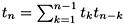
.

9.

.

10.

.

11.

The text defined classifications only for difference equations for a single sequence involving a single index variable. Nonetheless, we think you can figure out reasonable classifications for the following. Do so.

  1. C*(u, b)=C*( u ?1, b)+ C*( u, b ?1)

12.

Show that every second-order, nonhomogeneous, constant-coefficient difference equation with geometric nonhomogeneous part meets the assumptions of Theorem 1. (That is, you have to show that f is defined wherever it is supposed to be.) A geometric nonhomogeneous part is an expression of the form ar n for some nonzero constants a and r.

13.

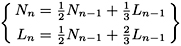
Consider the difference equation


Suppose that we set initial conditions r 0=1, r 1=2. Show that...

UNLIMITED FREE
ACCESS
TO THE WORLD'S BEST IDEAS

SUBMIT
Already a GlobalSpec user? Log in.

This is embarrasing...

An error occurred while processing the form. Please try again in a few minutes.

Customize Your GlobalSpec Experience

Category: Thermocouple Elements
Finish!
Privacy Policy

This is embarrasing...

An error occurred while processing the form. Please try again in a few minutes.