Discrete Algorithmic Mathematics, Third Edition

Problems: Section 5.6

1.

Determine the long-range behavior of the following sequences. You should be able to do this in your head, though you might confirm your answers with a graphics calculator.

  1. 2 n+3 n

  2. 3+(.5) n

  3. 3(1.1) n ?(1.2) n

  4. 3(1.1) n+( ?1.2) n

  5. 2(1.2) n+ 3( ?1.2) n

  6. (.9) n+2( ?.9) n

  7. 2(1.2) n ?3 n(1.2) n

  8. 2 n ?13(3 n)+.1(4 n)

  9. (2+4 n)2 n+( ?2.1) n

2.

Show that in the long term a n=2 n ?13(3 n)+ .1(4 n) behaves like .1(4 n) by rewriting a n in the form 4 n times something.

3.

Consider the recurrence


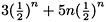
with a 0= a 1 =1, a 2=2. This comes from the modified rabbit problem of [12, Section 5.2]. Find, at least approximately, the long-term rate of growth for a n . Note: This recurrence cannot be solved by hand (unless you know about the general formula for roots of cubics), but there are several ways to answer the question using modest calculator power.

4.

4. Prove Theorem 1. The concepts and methods of Section 0.3 should help. The first step is to decide what the precise meaning of behaves like should be.

Answers

1.

a) ? ? b) ?3 d)

UNLIMITED FREE
ACCESS
TO THE WORLD'S BEST IDEAS

SUBMIT
Already a GlobalSpec user? Log in.

This is embarrasing...

An error occurred while processing the form. Please try again in a few minutes.

Customize Your GlobalSpec Experience

Category: Diodes
Finish!
Privacy Policy

This is embarrasing...

An error occurred while processing the form. Please try again in a few minutes.