Discrete Algorithmic Mathematics, Third Edition
Written in a lively, clear style that talks to the reader, this book is unique for its emphasis on algorithmics and the inductive and recursive paradigms as central mathematical themes.
 TABLE OF CONTENTS
 Before we can give general methods for solving classes of difference equations, we need some words to describe the classes we are talking about. The key phrases we need to define are kth order, linear, constant coefficient, and homogeneous.
As noted in Section 5.1, a difference equation relates terms in a sequence. Different terms have different indices (subscripts). The order of a difference equation is the difference between the highest and lowest indices in the equation. Consider
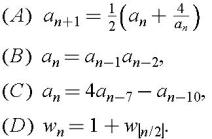
Equation (A) is first order because ( n+1) ?n=1. Equation (B) is second order. Another way to say this is that (B) relates terms that are at most two apart in the sequence. Equation (C) is tenth order. Finally, (D) has no fixed order because the difference between the highest and lowest indices is  , which changes as you move along the sequence.
A difference equation is linear if it expresses a term in the sequence as a sum of multiples of previous terms of the sequence plus, optionally, a nonhomogeneous part that does not involve terms in the sequence. When a difference equation has a nonhomogeneous part, then the whole equation is said to be nonhomogeneous. Any difference equation like (C) without a nonhomogeneous part is said to be homogeneous.
The following are linear:
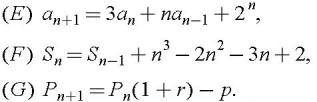
For instance, (E) expresses a n +1 as a multiple of a n (the multiple is 3) plus a multiple of