Discrete Algorithmic Mathematics, Third Edition

Written in a lively, clear style that talks to the reader, this book is unique for its emphasis on algorithmics and the inductive and recursive paradigms as central mathematical themes.
 TABLE OF CONTENTS
 Sometimes it s not important to have an exact value for a n . Sometimes it s even misleading: if the model that leads to a difference equation is not very exact, it would be wrong to believe in the exactness of the answer that comes from that difference equation. In such cases one might be more interested in qualitative results. For instance, what happens to the sequence in the long run? Does a n go to zero, head to some nonzero limit, oscillate indefinitely, go to plus or minus infinity, or what? In this section we will analyze long-term behavior. Occasionally we will assume basic familiarity with complex numbers.
Theorem 2, Section 5.5, says that every solution is a sum of geometric sequences or close relatives. Since the qualitative behavior of any one geometric series is easy to analyze, it is possible to piece together the behavior of any difference equation satisfying Theorem 2.
Analyze the long-term behavior of the following sequences:
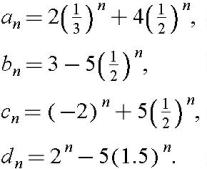
Solution For { a n}, the two geometric sequences are {  } and {
  }. Since the ratio in both cases is between 0 and 1, both sequences head towards 0. Therefore their sum goes to 0 as well. This is shown graphically in Figure 5.8a.
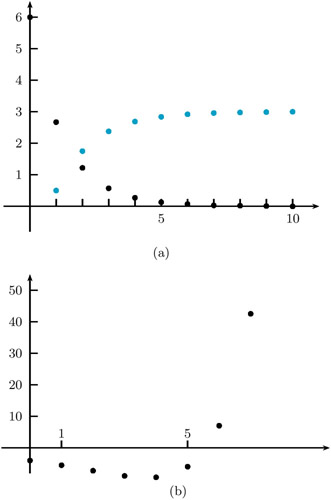
 (black) and
 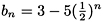 (color).
 For {b n }, the first geometric sequence is the constant sequence...