Electrical Engineering Problems and Solutions, Eighth Ed

This companion volume to Electrical Engineering License Review covers 100% of the main book's end-of-chapter problems with detailed step-by-step solutions.
 TABLE OF CONTENTS
 |
| SITUATION: A three-phase, 60 Hz, 173 kV, 50 mile long transmission power line delivers complex power to known load. The line has been tested for it's characteristic parameters. These parameters (on a per-phase basis) are found to be:
REQUIRED: For a known load at the end of the line of 75+j30 (three-phase, total megavolt-amperes), determine the input (sending) current and the input power necessary to support the complex load. |
|
Answers
|
| Solution (See Elgerd: "Basic Electric Power Engineering. Addison-Wesley, any edition.) The equivalent circuit may be represented as: 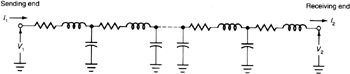 And a simpler approximation (on a per phase basis) is: 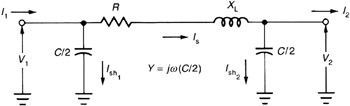 The complex power,S pp, (which may also be expressed as the phasor voltage times the complex conjugate of the phasor current) on a per phase basis is:  The current at the receiving end, then, is: 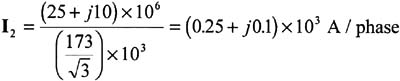 The shunt and series currents are then found 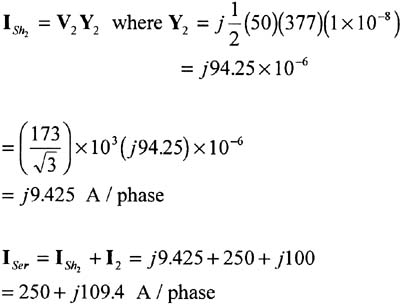 And the voltage drop across the series branch may be found by first finding the series impedance: 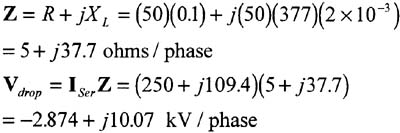 Therefore the input voltage is 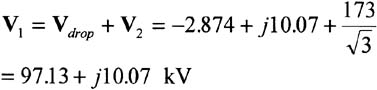 And the sending end shunt current is  Therefore the sending end current is  And then one may find the sending end complex power (again complex voltage times the complex conjugate of the current) as Complex Power = (97.13 + j10.07) 10 3(250.9 ? j118.55) = 25.56 + j1.38 mega volt-amps / phase And, of course, the total complex power is three times this... |