Filtering in the Time and Frequency Domains

This book stands as the most comprehensive treatment of filtering techniques, devices and concepts as well as pertinent mathematical relationships.
 TABLE OF CONTENTS
 Physically unrealizable responses have an important place in the theory of filtering. The postulate of one such system response immediately predetermines another response of the same system, and these response pairs contain valuable information for both the theoretician and the practicing engineer. Each response pair can be considered the limit of many realizable responses, hence it tells us what can be expected in practice. Furthermore, the origin of various response characteristics is exposed by examination of these ideal responses.
We initially determine the impulse responses and step responses corresponding to two fundamental magnitude responses, namely, the rectangular response and the Gaussian response. This is followed by a discussion of the Paley-Wiener condition, which tells us when a given frequency function can be the Fourier spectrum of a causal function. We conclude by relating the attenuation and phase of minimum-phase networks, for these are extensively used in practice.
Often the rectangular magnitude with linear phase response is called the ideal frequency-domain response because the passband attenuation is zero (unity gain), there is no transition band, and the stopband attenuation is infinite (zero gain). That is, in this LP response (Fig. 3-5 a),
| (3.1-1) |  |
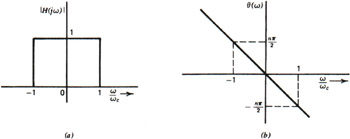
The phase response is the linear function (Fig. 3-5 b)
| (3.1-2) | 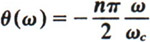 |
and consequently the group delay and phase delay are the same constant
| (3.1-3) | 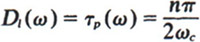 |
In practice one attempts to approximate this function...