Filtering in the Time and Frequency Domains

This book stands as the most comprehensive treatment of filtering techniques, devices and concepts as well as pertinent mathematical relationships.
 TABLE OF CONTENTS
 The increased use of pulsed waveforms in electronics requires filters with low-overshoot transient responses. Figure 3-31 a shows a typical series of RF pulse envelopes (carrier frequency is not shown) encountered in communication and radar systems. The essential information may be the phase or frequency of the RF signal, or its zero crossings. The response of the first pulse passing through an improperly designed filter is illustrated in Fig. 3-31 b. Signal overshoots exist where the response should ideally be zero, and they may be appreciable at the time that the response of the second pulse appears at the filter output, indicated by the dotted curve. Consequently the two signals add, destroying the phase information of the carrier frequency. This undesirable condition is known as intersymbol interference.
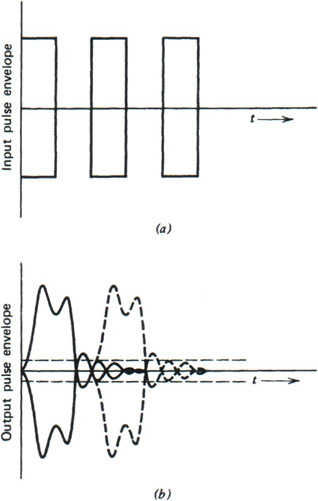
In certain radar systems, a prescribed threshold (the dashed line in Fig. 3-31 b) is specified, and any signal value greater than this threshold is considered a target return. Thus the first pulse overshoot indicates a target when none is present and creates a false alarm.
These are but two examples illustrating the desirability of filters with low-overshoot transient responses that rapidly decay with increasing time. The Gaussian time-domain response (no overshoots) is physically unrealizable as we showed in Section 3.1.5, but three realizable approximations to low-overshoot responses are now presented.
An nth-order Taylor approximation to the Gaussian magnitude function
| (3.6-1) |  |
is obtained...