Filtering in the Time and Frequency Domains

This book stands as the most comprehensive treatment of filtering techniques, devices and concepts as well as pertinent mathematical relationships.
 TABLE OF CONTENTS
 We choose the magnitude function associated with H( s) in (3.3-1) to have the form
| (3.4-1) | 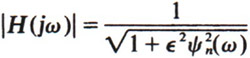 |
where ? is a positive, real number not greater than unity, and ? n( ?) is an nth-order polynomial containing only even or only odd powers of ?. If the value of ? n( ?) is small in the passband and large in the stopband, H( j ?) is a good approximation to the rectangular magnitude response in Fig. 3-5 a. Four classes of filter responses obtained in this manner are now discussed.
Setting ? - 1 and ? n( ?) = ? n in (3.4-1) yields the Butterworth response
| (3.4-2) | 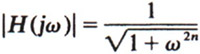 |
Reference to Section 3.2.1 shows that H( j ?) 2 satisfies the maximally flat criterion at ? = 0, since the required coefficients of powers of ? are zero. As we demonstrated in Example 3-4, a Taylor approximation by H( j ?) 2 is also a Taylor approximation by H( j ?). Since H( j ?) is unity at ? =0 and 1/  at ? = 1 independent of the approximation order n, it is normalized.
The transfer function, obtained by the technique in Example 2-27, is listed in (3.4-3) for n = 2, 3, and...