Filtering in the Time and Frequency Domains

This book stands as the most comprehensive treatment of filtering techniques, devices and concepts as well as pertinent mathematical relationships.
 TABLE OF CONTENTS
 The constant group delay, which corresponds to linear phase, can also be approximated using the maximally flat, equiripple, and least-squares criteria. The delay function for the nth-order all-pole filter, obtained from (2.6-10), is
| (3.5-1) | 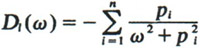 |
Examples 3-7 and 3-8 have already considered these approximations for first-order systems, and we now turn to the general cases. The area under the delay curve-that is, the integral of D i( ?)-is n ?/2, a constant independent of the pole locations.
The first English language account of work on the maximally flat delay was reported by Thomson [27]; an earlier publication had appeared in Japan [13]. This filter is often called a Thomson filter or a Bessel filter. A direct method of obtaining maximally flat delay at ? = 0 is to express D 1( ?) as a rational function in ? 2 and then equate like powers of ? 2 in the numerator and denominator, as discussed in Section 3.2.1. Then the first 2 n - 1 derivatives of D i( ?) will be zero at ? =0.
This technique is now illustrated for the third-order transfer function
| (3.5-2) |  |
The delay function, in the form of (3.2-15), is
| (3.5-3) | 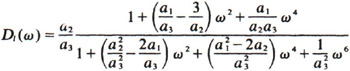 |
For maximal flatness,
| (3.5-4) | 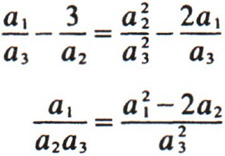 |
There are two equations and three unknowns; thus as is customary the zero frequency delay is set to unity, implying a 2 = a 3