Formulas for Structural Dynamics: Tables, Graphs and Solutions
Chapter 12: Non-Uniform One-Span Beams

In this chapter, free vibration analyses of non-uniform one-span beams with different boundary conditions are presented. Continuous and stepped beams are investigated.

NOTATION

A

Cross-sectional area of the beam

E

Modulus of elasticity of the beam material

EI

Bending stiffness

h, d, b

Geometrical dimensions of the cross-sectional of the beam

I

Moment of inertia of a cross-sectional area of the beam

k

Stiffness coefficient of a transversal spring

k F

Stiffness coefficient of the elastic foundation

l

Length of the beam

t

Time

x

Spatial coordinate

x, y, z

Cartesian coordinates

X(x)

Mode shape

y(x, t)

Lateral displacement of the beam

?

Taper parameter

?

Frequency parameter

?, m

Density of material and mass per unit length of beam, m = ? A

?

Flexibility constant of the rotational spring

?

Circular natural frequency of the transverse vibration of the beam

12.1 CANTILEVER BEAMS

12.1.1 Wedge and truncated wedge

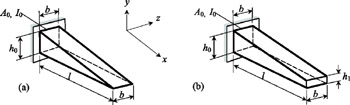
A wedge and truncated wedge of length l are presented in Figs. 12.1(a) and (b).


Figure 12.1: Tapered cantilever beam: (a) wedge; (b) truncated wedge.

The differential equation for the Bernoulli Euler theory


where r( x) is the radius of gyration of a cross-section about an axis through its centre parallel to the z axis.

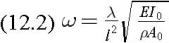
Wedge. The natural frequency of vibration is


where A 0 = cross-sectional area in the root section

I 0 =...

UNLIMITED FREE
ACCESS
TO THE WORLD'S BEST IDEAS

SUBMIT
Already a GlobalSpec user? Log in.

This is embarrasing...

An error occurred while processing the form. Please try again in a few minutes.

Customize Your GlobalSpec Experience

Category: Ion Beam Guns and Electron Beam Guns
Finish!
Privacy Policy

This is embarrasing...

An error occurred while processing the form. Please try again in a few minutes.