Formulas for Structural Dynamics: Tables, Graphs and Solutions
This chapter deals with the vibration of frames. Eigenvalues for symmetric portal frames, symmetric multi-storey frames, viaducts, etc. are presented. A detailed example of the calculation of non-regular frames is discussed.
| A | Cross-sectional area | |
| B, C, S, D, E | Hohenemser Prager functions | |
| E | Young's modulus | |
| EI | Bending stiffness | |
| F, H, L, R | Frequency functions | |
| g | Gravitational acceleration | |
| I | Moment of inertia of a cross-sectional area | |
| k, ? | Dimensionless geometry parameters | |
| l, h | Length of frame element | |
| m | Mass per unit length | |
| M | Concentrated mass | |
| r ik | Unit reaction | |
| t | Time | |
| x | Spatial coordinate | |
| y | Transversal displacement | |
| Z | Unknown of the slope-deflection method | |
| ? | Dimensionless mass ratio | |
| ? | Frequency parameter, ? 4 EI = ml 4 ? 2 | |
| ? | Density of material | |
| v | Eigenvector | |
| ? | Natural frequency, ? 2 = ? 2 EI/ ml 4 |
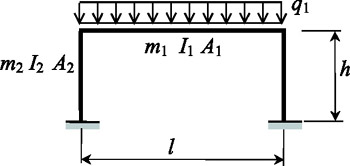
A portal symmetric frame with clamped supports is shown in Fig. 16.1. The distributed masses of elements per unit length are m 1 and m 2. Additional distributed load, which is carried by horizontal and vertical elements, are q 1 and q 2, respectively (load q 2 is not shown).
The differential equation for each member is
where q i/ g is the mass per unit length of the distributed load, and