Fourier Transform in Radar and Signal Processing
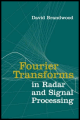
This text presents an integrated approach to carrying out Fourier transforms and establishes a unified system, details how complex functions can be broken down for analysis, and much more.
 TABLE OF CONTENTS
 The problem to be tackled is that of compensating for a given frequency-dependent distortion in a communications channel, as illustrated in Figure 6.1. A waveform u with baseband spectrum U is received with some channel distortion G such that at (baseband) frequency f, the spectral component received is G( f) U( f) instead of just U( f). The signal is then passed through a filter with frequency response K( f) such that the output spectrum K( f) G( f) U( f) is close to the undistorted signal spectrum U( f). Clearly, the ideal required filter response at frequency f is simply K( f) = 1/ G( f), but in practice this filter may not be exactly realizable, for example, if it is an FIR digital filter (except in the unlikely case that K consists of a set of ?-functions corresponding to a number of delays at multiples of the sampling frequency). In this case, we design the filter to give a best fit, in some sense, of K( f) G( f) U( f) to U( f) over the signal bandwidth. In fact, the fit we choose is the least squared error solution, a natural and widely used criterion, which has the advantage of yielding a tractable solution, at least in principle, and...