Fourier Transform in Radar and Signal Processing
This text presents an integrated approach to carrying out Fourier transforms and establishes a unified system, details how complex functions can be broken down for analysis, and much more.
 TABLE OF CONTENTS
 Although the function G, describing the channel frequency response to be compensated, can be defined over the whole frequency domain, we are only interested in its form in the frequency interval containing significant signal energy. If, as we have generally assumed, the signal is limited (after down-conversion to complex baseband) to the band ( -F/2, F/2), then it will make no difference in the Fourier transform integrals of (6.6) and (6.7) if the function rect ( f/ F) is included, as the factor U( f) 2 is taken to be zero anyway in the region where this rect function is zero. Thus, if we consider first the case where G is a linear function of frequency, to avoid the problem of the function G( f) = af + b being unbounded as f ? ?, we can take, more conveniently, G( f) = ( af + b) rect ( f/F). In order to handle polynomial functions of this kind, we introduce the function ramp defined by
| (6.11) |  |
and this is illustrated in Figure 6.2.
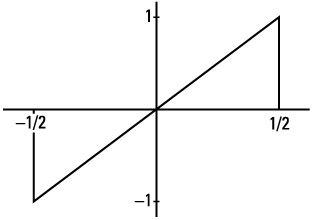
Thus ramp ( x) = 2 x on -1/2 < x < 1/2, and ramp ( x) = 0 for x < -1/2 and x > 1/2. [If required, we can take ramp ( 1/2) = 1/2.] As the rect...