Fourier Transform in Radar and Signal Processing
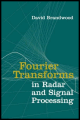
This text presents an integrated approach to carrying out Fourier transforms and establishes a unified system, details how complex functions can be broken down for analysis, and much more.
 TABLE OF CONTENTS
 Many antennas for use in radio, radar, or sonar systems consist of an array of simple elements, rather than, in some radio cases, a single element or, for radar and satellite communications, a large parabolic dish or even an exponential horn. For maximum signal-to-noise ratio (whether on transmission or reception) in a particular direction, the signals passing through the elements must be adjusted in phase so that they sum in phase at the frequency of operation. Of course, in practice all signals occupy a finite bandwidth, so that in principle different phase shifts are needed across this band, as it is really a time difference, dependent on element position, that needs compensation. However, many signals are narrowband in that the fractional bandwidth, the ratio of the bandwidth to the carrier frequency, is small. In this case the phase shift required across the band is close to that at the center frequency, and as it is much easier to apply a simple (frequency-independent) phase shift than a delay, this approximation can be used. Whether this approximation is acceptable or not in a given system depends not only on the fractional bandwidth, but also on the size, or aperture, of the array. Thus, narrowband is a relative term, and perhaps the most appropriate definition of a narrowband signal in this context is that it can be termed narrowband if ignoring its finite bandwidth leads to negligible, or practically acceptable, errors. Conversely, a broadband signal as...