Fourier Transform in Radar and Signal Processing
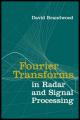
This text presents an integrated approach to carrying out Fourier transforms and establishes a unified system, details how complex functions can be broken down for analysis, and much more.
 TABLE OF CONTENTS
 The illustrations of the use of the rules and pairs technique in Chapters 3 to 7 show a wide range of applications and how some quite complex problems can be tackled using a surprisingly small set of Fourier transform pairs. The method seems to be very successful, but on closer inspection we note that the functions handled are primarily amplitude functions-the only phase function is the linear phase function due to delay. Topics such as the spectra of chirp (linear frequency modulated) pulses or nonlinear phase equalization have not been treated, as the method, at least as at present formulated, does not handle these. There may be an opportunity here to develop a similar calculus for these cases.
A considerable amount of work, in Chapters 5 and 6, is directed at showing the benefits of oversampling (only by a relatively small factor in some cases) in reducing the amount of computation needed in the signal processing under consideration. As computing speed is increasing all the time, it is sometimes felt that little effort should go into reducing computational requirements. However, apart from the satisfaction of achieving a more elegant solution to a problem, there may be good practical reasons. Rather analogously to C. Northcote Parkinson's law, "work expands so as to fill the time available for its completion," there seems to be a technological equivalent: "user demands rise to meet (or exceed) the capabilities of equipment." While at any time an advance in speed of computation may enable current problems...